
Auto Repair SEO Case Study | 578 Calls From Google Maps
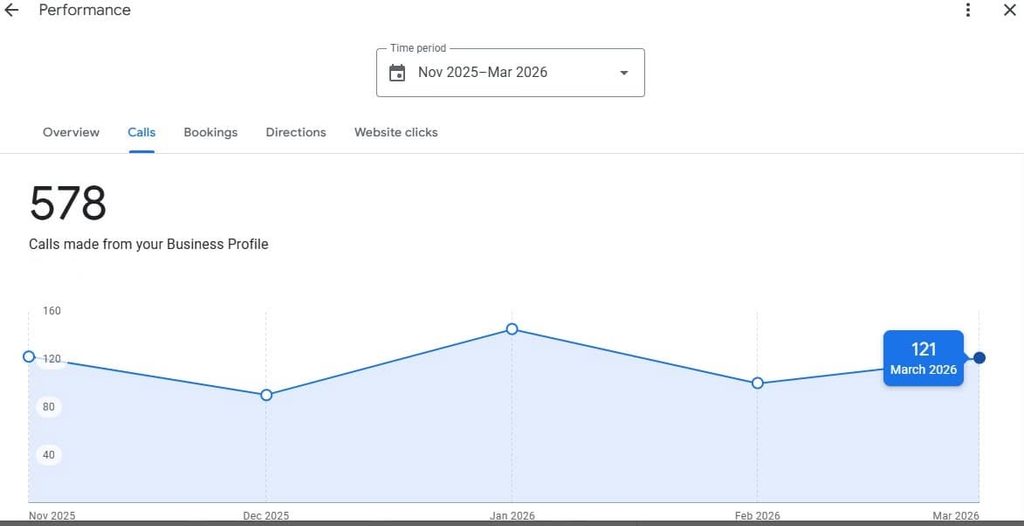
This shop had a five-star reputation and a bay that sat empty two days a week. The problem was never the work. It was that nobody searching “mechanic near me” three streets away could see them. In one quarter their Google listing produced 3,305 customer interactions and 578 direct phone calls.
Independent Auto Repair Shop
Client
90 Days
Timeline
Automotive Repair
Industry
Meet the Business
A family-run auto repair shop with two lifts, three technicians and roughly fifteen years of local reputation. Brakes, diagnostics, timing belts, pre-purchase inspections — the kind of shop people recommend to their neighbours once they find it.
The word there is find. Almost every new customer arrived by word of mouth or by driving past. Nothing was coming from search. When the owner typed his own services into Google from home, a mile and a half away, his shop was nowhere in the three map results Google shows. Two national chains and a franchise took all three slots.
A broken car is an emergency purchase. People do not browse, compare five shops and read reviews for a week. They search once, tap one of the first three results, and call. If you are not in those three results at the moment the search happens, the job is gone — and you never learn it existed.
The Challenge
We started by mapping where the shop actually ranked, not where the owner assumed it did. We ran a grid of search points across the service area and checked the map pack position at each one. The result was a listing that ranked well on top of its own building and collapsed within about half a mile in every direction.
- The Google Business Profile was a placeholder. One category, no services listed, no products, three photos uploaded at setup and never touched again, no posts, no questions answered.
- Reviews were good but stale. Forty-one reviews averaging 4.8 stars — and the most recent one was eleven months old. Google reads recency, not just rating.
- The website was one page. A homepage listing every service in a bulleted paragraph. No page existed that a search engine could match to “brake repair” or “check engine light diagnostic”.
- The name, address and phone number disagreed across the web. An old suite number on one directory, a disconnected mobile on another, a misspelled street on a third.
- Nothing was measured. No call tracking, no Search Console, no way to know whether last month was better or worse than the one before.
Put plainly: Google had no strong reason to believe this shop served anywhere beyond its own car park, and no fresh evidence that it was still trading.
What We Actually Did
Two workstreams ran in parallel: the Google Business Profile and the website. Neither works properly without the other. A perfect listing pointing at a thin website stalls; a good website with a neglected listing never reaches the map pack at all.
1. Rebuilding the Google Business Profile
- Primary category corrected to Auto Repair Shop, with secondary categories added for Brake Shop, Auto Tune Up Service, Car Inspection Station and Oil Change Service. Category choice is one of the strongest ranking levers in the map pack and it was being wasted on a single generic entry.
- Every service entered individually with its own written description — nineteen in total — rather than left to Google to infer from the business name.
- Service area defined properly across the surrounding towns the shop genuinely covers, instead of a default radius.
- Geo-tagged photography: the premises, the bays, the team, the equipment, and a steady drip of job photos uploaded weekly rather than in one batch.
- Weekly Google Posts covering seasonal work — winter checks, air-conditioning regas, service reminders — each one an additional freshness signal and an extra surface in search.
- Questions seeded and answered with what the front desk fields every day: do you take walk-ins, do you do courtesy cars, do you work on hybrids.
- A review system the shop could actually run. A printed card and an SMS follow-up at key handover, plus written replies to every review inside 48 hours. Reviews went from eleven months stale to a steady weekly trickle.
- Booking and messaging enabled so the listing could convert without a phone call for customers who prefer not to ring.
2. Rebuilding the Website Around Searchable Jobs
- One page per service. Brakes, clutches, diagnostics, air conditioning, suspension, exhausts, pre-purchase inspections. Each page answers what the job involves, what it typically costs, how long it takes and what happens if something else is found.
- Town pages for the genuine catchment, each one written about that town — not a template with the name swapped. Thin duplicated location pages are worse than none.
- Service schema rather than LocalBusiness schema on the service pages, with the towns covered listed as the area served. This describes the shop accurately to search engines without duplicating the physical-location markup that belongs only on the contact page.
- Technical cleanup: the site went from a 6.4-second mobile load to under two seconds, image weight dropped by around 70%, and a proper internal link structure connected the town pages to the service pages.
- Phone numbers made tappable and moved above the fold on mobile. Most repair searches happen on a phone, standing next to a car that will not start.
- Local citations corrected and rebuilt across the directories that carry weight for automotive, with one identical name, address and phone everywhere.
The Results
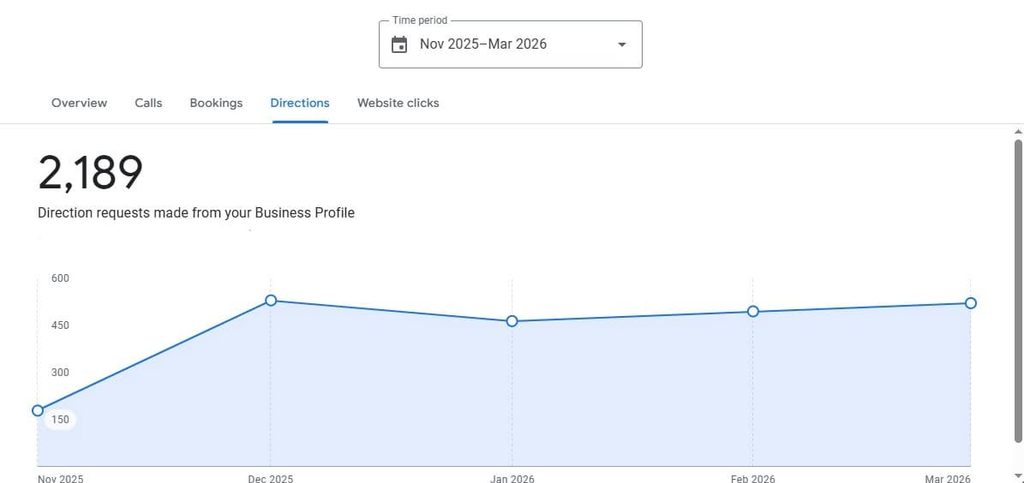
These figures come straight from the shop’s own Google Business Profile performance report for the period. They are not estimates or projections.

Direction requests are the highest-intent signal a local listing produces. Nobody asks for driving directions to a garage out of curiosity. That figure represents two thousand people who had already decided to come, and who needed the shop to exist on a map to do it.
Before and After
| Measure | At the start | After 90 days |
| Map pack visibility across the service area | Ranked only within roughly half a mile of the premises | Visible across the core catchment towns |
| Phone calls from the listing | Not tracked — owner estimated “a handful a month” | 578 in the quarter |
| Direction requests | Not tracked | 2,189 in the quarter |
| Website pages targeting a specific job | 0 | 7 service pages plus town pages |
| Most recent Google review | 11 months old | Within the last 7 days, consistently |
| Mobile page load | 6.4 seconds | Under 2 seconds |
Services Provided
- Local SEO
- Google Business Profile rebuild and ongoing management
- Review generation system and response management
- Website design and development
- Service and location page content
- Citation cleanup and local link building
What the Owner Said
Key Takeaways
A good shop with a neglected listing is an invisible shop
Nothing about the quality of this business changed in ninety days. The work was the same, the team was the same, the prices were the same. The only thing that changed was whether Google could tell who they were, what they did and where they did it — and that was worth 578 phone calls.
Categories and services are not paperwork
The single largest movement in map visibility came from fixing the category set and entering every service individually. It took an afternoon. It had been left undone for years.
Review recency beats review count
Forty-one reviews at 4.8 stars sounds strong until you notice the newest is nearly a year old. A steady weekly trickle of fresh reviews moved the listing further than the historic average ever did.
The listing and the website are one system
The map listing wins the search. The service page wins the decision. Fixing one without the other caps how far either can go.
Want to know where your shop actually ranks?
Not on your own street — across the towns you want work from. We will run the same grid check we ran here and show you the map, free.
- A visibility grid across your real service area
- A plain list of what is holding the listing back
- What the fix would involve and what it would cost
- No contract, no obligation, no sales script
Ready to Achieve Similar Results?
Every business is unique, but success follows proven strategies. Let’s discuss how we can create a custom solution for your specific goals and challenges.