

There is no such thing as ranking “in Kansas”. Google does not hold a single statewide list of plumbers or dentists or roofers and hand it out to everyone. It builds a fresh list for every person, based on where that person is standing when they search.
So a business can be the first result in Wichita and completely absent in Derby, nine miles away. Same business. Same website. Same reviews. The map just moved, and the answer moved with it.
Key Takeaway
Local search in Kansas is won street by street, not state by state. Your ranking changes as your customer moves across town, which means the only honest question is “where am I visible, and where am I not?” That question has a measurable answer, and it is where every piece of work we do begins.
Why Kansas search is decided town by town
Google ranks local businesses by distance from the searcher first, so your visibility shrinks the further a customer is from your front door.
Picture someone in Olathe searching for your trade. Google draws a circle around them and asks which businesses are close, open, relevant and well reviewed. If you sit in Topeka, you lose that circle before anything else is considered.
This is why owners get confused. You search your own name, you see yourself at the top, and you assume you are fine. You are standing at your own address. Google is telling you something about where you are, not about where your customers are.
Kansas makes this sharper than most states. Wichita, Kansas City, Overland Park and Topeka are dense and crowded. Drive thirty minutes and the competition thins out dramatically. The work is the same shape everywhere. The difficulty is not.
| What decides it | The box at the top | The plain blue links |
| Biggest single factor | How close you are to the person searching | How well your page answers that exact search |
| Reviews | Heavily weighted, and recent ones count more | Indirect, but they affect whether people click |
| How long a change takes | Days to a few weeks to show movement | Weeks to months, and slower in crowded cities |
| The next town over | You fade fast once you leave your own area | You can hold on, if the page is written for that town |
What this means for you
Before anyone sells you work, you should know which streets you already win and which ones you lose. Everything after that is just deciding how far out you want to push.
What we actually do
We measure where you rank across a grid of real locations, fix the profile and the pages that feed it, then build coverage outward one area at a time.
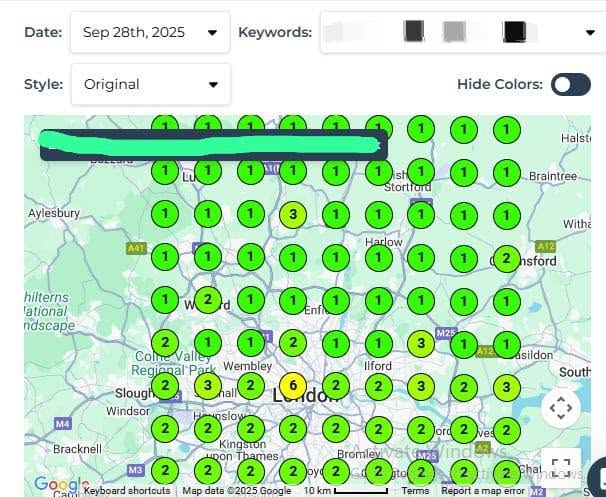
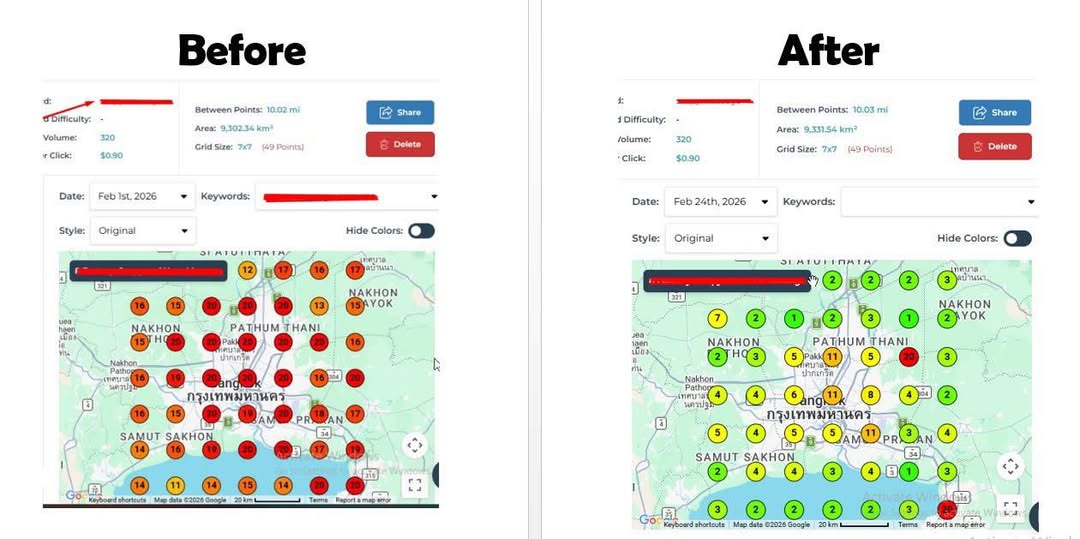
- Map your current coverageWe run a rank grid, which checks your position from dozens of points across your service area instead of one. You see a colour map of where you win and where you vanish.
- Rebuild the Google Business ProfileCategories, services, hours, description, photos and the attributes Google reads. This is the single biggest lever on the three businesses in the box at the top of Google.
- Fix the listings elsewhereYour name, address and phone number need to match everywhere they appear online. Mismatches quietly hold a listing back.
- Write the pages that carry the townsA real page for each service and each area you want. Not a template with the town name swapped out.
- Get reviews coming in steadilyA system that asks every customer, every time, without ever offering anything in return.
- Build the links and mentionsLocal sponsorships, suppliers, associations, press. Slow, unglamorous, and it is what moves the plain blue links underneath.
- Re-run the grid and reportSame grid, same points, every month. You compare pictures, not opinions.
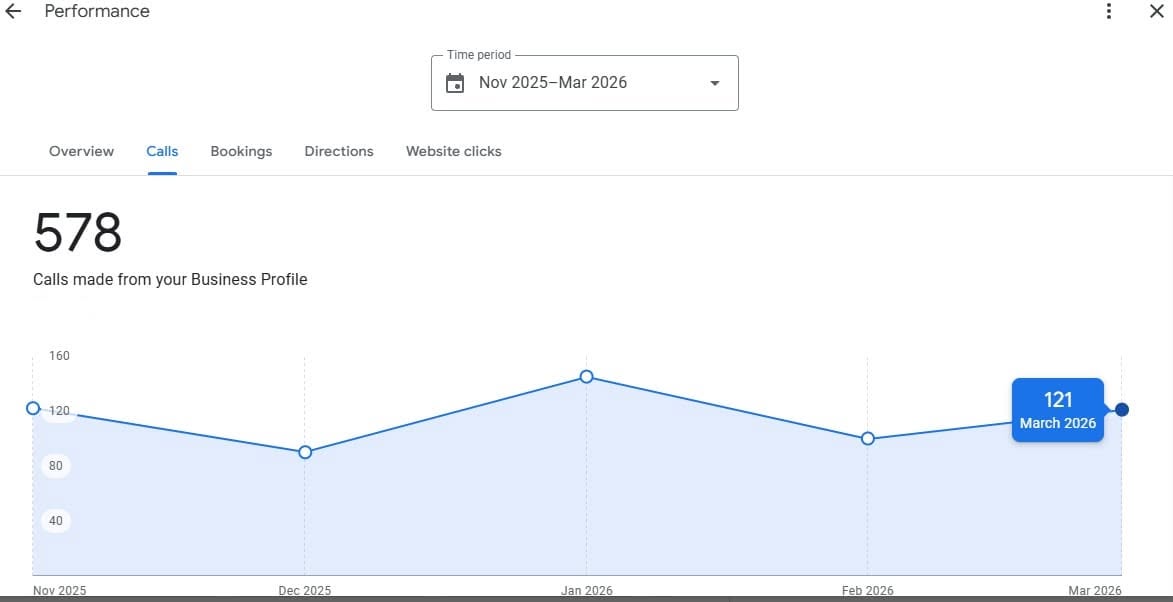
One HVAC company went from a single listing to coverage across thirty towns, reaching 564 search clicks.
Below this page you will find every Kansas city we have published a page for, with links to each.
What changes when you want more than one town
Expanding beyond your home town means earning relevance in places where distance is working against you, and that takes real pages and real proof, not a changed address.
Most owners try the shortcut first. They add towns to the business description, or spin up thin pages with the town name dropped in. Google has seen that pattern for years and it does almost nothing.
What does work is evidence that you serve the place. Jobs completed there, reviews from customers there, photos taken there, a page that reads like it was written by someone who has been.
- Build one proper page per town you genuinely serve, with local jobs and local detail
- Ask for reviews from customers in the outlying towns, not just the ones near base
- Add service areas to your profile honestly, matching where you actually travel
- Expand outward in order, nearest town first, rather than all at once
- Do not rent a mailbox or use a friend’s address in another town
- Do not list towns you cannot reach in a reasonable drive
- Do not publish twenty near-identical pages with the names swapped
- Do not expect the box at the top to follow you far from your real address
What it costs
Retainers start at $1,250 a month, and that covers the profile work, the pages, the review system, the link building and the monthly rank grid.
Price moves with scope, not with postcode. One town is one price. Eight towns in the Kansas City metro is more work, so it costs more. We cover 26 trades and the shape of the work is similar across them.
There is no separate charge for the reporting, and nothing is billed on performance. You pay for work done. What that work produces is visible in the grid every month, and you can judge it yourself.
How long before it works
Expect small movement in the first month, clear movement by month three, and a settled picture around month six — and in Wichita or Overland Park, longer than that.
That range is deliberately unflattering. Anyone who tells you four weeks is either very lucky or not telling you the truth. Profile fixes can move fast. Pages and links do not.
| When | What changes |
| Month one | Baseline grid run. Profile rebuilt, categories and services corrected, listings cleaned up, review requests start going out. You may see early movement on the grid close to your address. |
| Month three | Service and area pages published and indexed. Review count climbing steadily. The grid typically shows a wider green area around your base than it did on day one. |
| Month six | Links and local mentions beginning to tell. The plain blue links start responding. Coverage in neighbouring towns becomes a fair question to ask. |
What this means for you
Judge the first three months on work completed and grid movement, not on phone calls. Judge months four to six on calls. That is the honest order.
The one thing that will get your listing suspended
Offering anything at all in return for a review breaches Google’s policy and can cost you the listing your business runs on.
It gets suggested constantly. A $25 gift card. Ten percent off the next service. A prize draw for everyone who leaves five stars. A bonus for the tech with the most reviews that month. We refuse all of it, every time it comes up.
This will get your listing suspended
Do not offer money, discounts, prize draws, free work or staff bonuses in exchange for reviews. Google treats incentivised reviews as a policy breach. A suspended profile disappears from the box at the top of Google entirely, and reinstatement is slow and not guaranteed. Ask every customer, ask politely, and offer nothing.
The legitimate version works anyway. Ask at the right moment, make the link one tap, ask every single customer. That is boring and it compounds.
Can one SEO campaign cover the whole of Kansas?
Not in the way most people mean it.
A single physical location cannot sit in the box at the top for Wichita, Topeka and Kansas City at the same time, because distance from the searcher rules that box. What a statewide campaign can do is build strength in the plain blue links underneath, so your pages turn up for searches across a much wider area. If you need the map results in several cities, you usually need a real presence in each one, with staff and an address that genuinely exists there.
Is SEO worth it if I am in a smaller Kansas town?
Often it is worth more there than in a city.
In a crowded metro you are competing against dozens of established businesses with years of reviews behind them. In a smaller town, many of your competitors have an unclaimed profile, the wrong categories and four reviews from 2019. The ceiling is lower because there are fewer searches, but the cost of reaching the top is much lower too. The honest way to find out is to measure the area first and look at who is actually there.
Do I show up when someone asks ChatGPT or Google’s AI for a business like mine?
Sometimes, and the work that makes it likely is the same work that wins the map pack.
AI answers are assembled from the same underlying information Google reads to build the box at the top: your business profile, your categories, the services you list, your reviews and what other sites say about you. If that information is thin or wrong, there is nothing for an AI answer to pick up. We do not claim to work on any named AI product and cannot promise you will be included. We make sure the information those systems read is accurate, complete and consistent.
What if I already have an SEO company?
Ask them for a rank grid before you do anything else.
A grid shows your position from many points across your service area, not just from your own desk. If your current agency cannot produce one, they are probably reporting on traffic rather than on where you are visible. Look at what has actually been published on your site in the last six months, and look at how many reviews have arrived. Those two things are hard to fake. If both look healthy, stay where you are.
See where you rank across your area
A short call. We run a rank grid for your business before we speak, so you can see your real coverage across your town and the ones next to it. Then we talk about what it would take to widen it.
- A rank grid showing where you win and where you vanish
- A plain look at who is above you and why
- What the first ninety days would involve, and what it costs
- No contract to sign on the call
- No promised rankings or lead numbers
Book a free strategy sessionEvery result on this page is published in full. Read the case studies.