

Florida is not one search market. It is hundreds of small ones, sitting next to each other, each with its own set of results.
There is no such thing as ranking “in Florida”. You rank in the towns where your customers are standing when they pick up their phone. Everywhere else, you do not exist.
Key Takeaway
Google decides local results by where the searcher is, not where your state line is. A plumber ranking well in Lakeland can be missing entirely in Winter Haven, fifteen minutes up the road. So the work is done town by town, and the honest question is never “can you rank me in Florida” but “which towns do you actually need”.
Why Florida search is decided town by town
Google builds local results around the searcher’s location, so your visibility changes as customers move a few miles in any direction.
Someone searching in Jacksonville gets one set of three businesses in the box at the top of Google. Someone searching in Ocala gets a completely different three. Neither result knows the other exists.
That is why a Florida business owner can feel successful and invisible at the same time. You show up when you search from your own desk. You vanish when a customer searches from the next town.
The plain blue links underneath behave differently again. Those move slower, care less about distance, and reward pages written about a specific place.
| What decides it | The box at the top | The plain blue links |
| Biggest factor | How close you are to the searcher | How well the page matches the town and the job |
| Reviews | Heavy influence, especially recent ones | Some influence, mostly indirect |
| How long a change takes | Days to a few weeks | Weeks to a few months |
| The next town over | Often a separate fight you have not started | Needs its own page written for that town |
What this means for you
Judging your SEO by searching your own name from your own office tells you almost nothing. The useful test is what a stranger sees from the far side of your service area.
What we actually do for a Florida business
We map where you currently show up across your service area, fix the listing that feeds the map results, then build the pages that hold the towns you want.
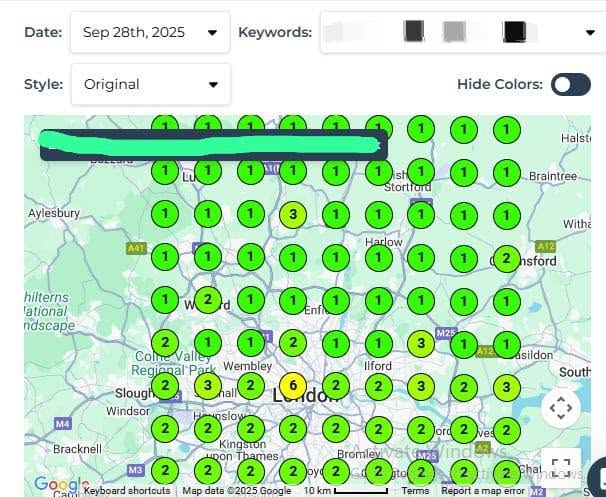
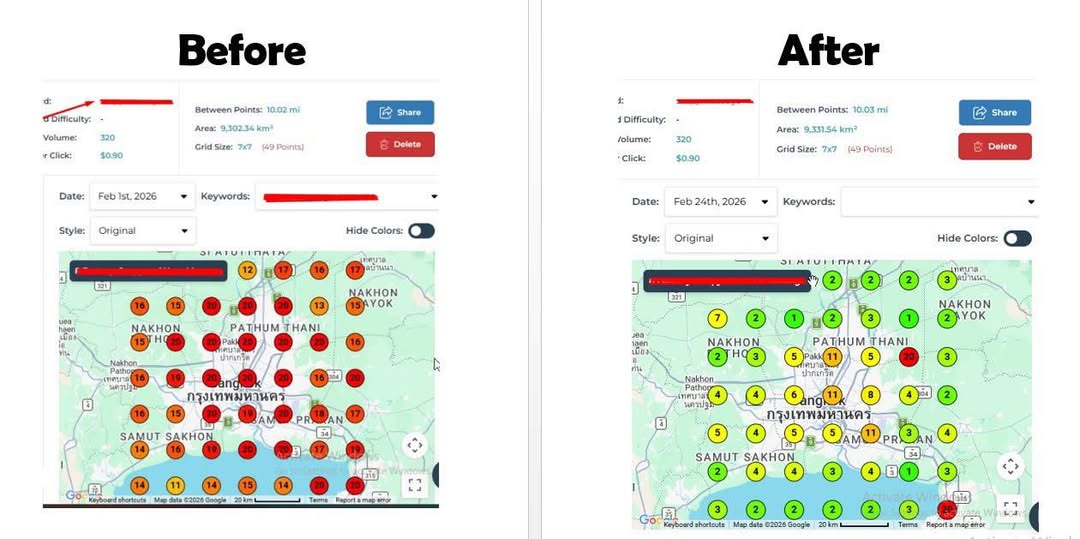
- Run a rank gridWe check your position from dozens of points across your service area, so you can see the towns where you are already invisible.
- Audit the Google Business ProfileCategories, services, hours, photos and the description all get checked against what people actually search for.
- Fix the listing itselfWrong primary category is the most common single problem we find, and it caps everything else.
- Build a review routineA simple, compliant way to ask every customer, so reviews arrive steadily instead of in bursts.
- Write the town pagesOne page per town you genuinely serve, written about that town and the work you do there.
- Clean up the citationsName, address and phone made consistent across the directories Google cross-references.
- Re-run the grid monthlySame points, same search, so progress is measured rather than described.
Below this you will find every Florida city we have published a page for, with a link to each one.
What changes when you want more than one town
Each extra town is a separate piece of work, because the box at the top of Google treats it as a separate contest.
A contractor covering both Lakeland and Winter Haven is not running one campaign. He is running two, from one address, with one profile doing the heavy lifting in both.
That is workable. It is just slower, and it needs honest priorities. Picking the two towns that pay best beats spreading thin across eight.
- Rank your towns by the value of the jobs you get from each one
- Start with the town you already half-rank in, because it moves first
- Give every town you target its own page with real detail about that town
- Be ready for the furthest towns to take the longest
- Do not list towns on your website that you would not actually drive to
- Do not create a second Google listing at an address you do not staff
- Do not use a mailbox or a friend’s garage as a second location
- Do not expect one page to carry six towns at once
What it costs
Retainers start at $1,250 a month.
That covers the profile work, the review routine, the town pages, the citation cleanup and a monthly rank grid so you can see movement rather than take our word for it.
Price moves with how many towns you want and how contested they are. A single-town business is at the bottom of the range. Someone chasing a wide radius across several markets is not.
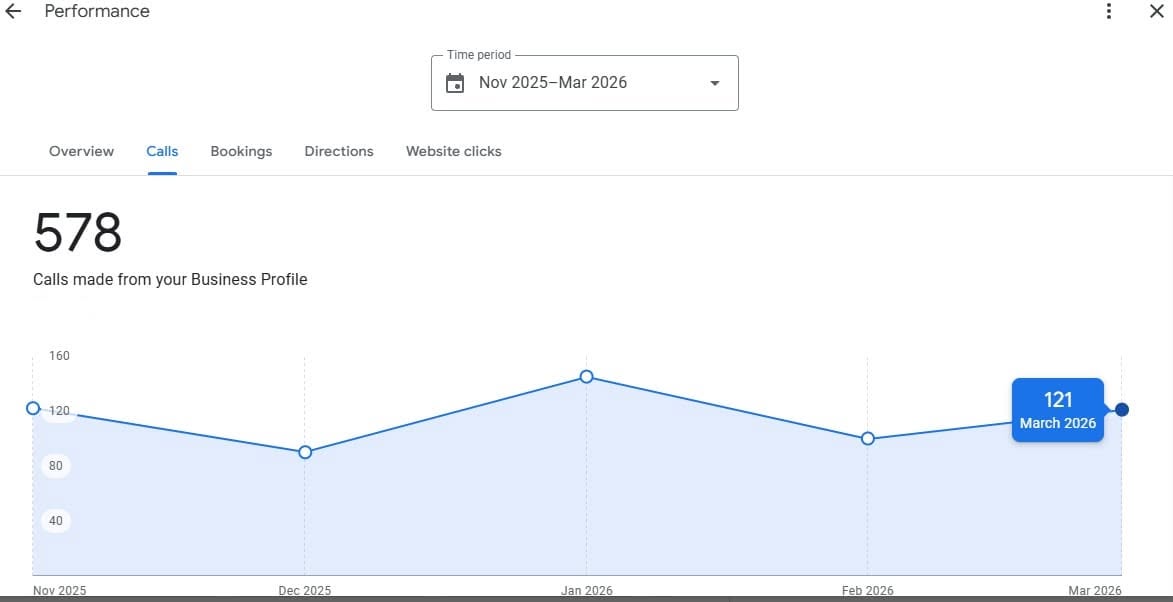
An HVAC company went from one listing to visibility across thirty towns, and recorded 564 search clicks.
How long before it works
Expect small movement inside the first month, something you can feel around month three, and a fair judgement at month six.
Some things move fast. A wrong primary category fixed on a Monday can change results by the weekend. A roofing contractor in one of our case studies turned his grid around in 23 days.
Most things do not move that fast. The plain blue links are slower, and a town where you are currently nowhere takes longer than a town where you are already fourth.
| When | What changes |
| Month one | Baseline grid run, profile rebuilt, categories and services corrected, review routine started. You may see movement in the towns closest to you. |
| Month three | Town pages live and indexed, citations consistent, reviews arriving steadily. The grid usually shows a wider green area than the baseline. |
| Month six | Enough months of grids to see a trend rather than a wobble. You can judge which towns are earning their keep and which need more work. |
What this means for you
If someone tells you six weeks to the top across your whole Florida service area, they are selling you the timeline you want rather than the one that exists.
The one thing that will get your listing suspended
Paying for reviews, in any form, is the fastest way to lose the listing your phone depends on.
It gets suggested constantly. A ten dollar gift card. A discount off the invoice. A monthly prize draw for anyone who leaves five stars. A bonus for whichever crew member collects the most.
We will not set that up, and we will tell you to stop if you already have. It breaches Google’s policy, the reviews can be wiped, and the profile itself can be taken down.
This will get your listing suspended
Never offer money, discounts, prize entries, free work or staff bonuses in exchange for a review. Ask every customer, every time, and offer nothing. That is the only version that is safe, and it is also the version that builds a review profile Google trusts.
Can you rank me across the whole of Florida?
Not in the way that phrase suggests, and anyone who says yes is describing something that does not exist.
The box at the top of Google is built around the searcher’s location, so there is no single statewide result to win. What you can do is win the towns you actually serve, one at a time, starting with the ones closest to you. A business trading in Jacksonville and one trading in Ocala are in separate contests that never touch. If you genuinely operate statewide, the honest plan is a list of target towns in priority order.
Which trades do you work with?
We cover 26 trades, all of them local service businesses that depend on the phone ringing.
That includes the usual home service trades, vehicle and repair businesses, and a range of professional services that sell within a driving radius. The pattern is the same across all of them. Somebody has a problem, they search on a phone, and they call one of the first few options they see. Because the shape of the work repeats, we already know what breaks first in most listings. Tell us your trade on the call and we will tell you where the pattern usually falls apart.
Do I show up when someone asks ChatGPT or Google’s AI for a business like mine?
Sometimes, and the same work that wins the map results is what makes it more likely.
AI answers about local businesses are assembled from the same material the box at the top of Google reads. The profile, the primary category, the services listed, the hours and the reviews. If that information is thin, wrong or contradicted across the web, there is little for an AI answer to pick up and name. We do not claim to work on any named AI product, and nobody can promise you a place in an AI answer. We fix the source material, because that is what these systems read.
I already pay someone for SEO. How do I tell if it is working?
Ask for a rank grid across your service area, run monthly from the same points.
A grid shows your position from dozens of locations, not just from wherever you happen to be sitting. It tells you which towns you hold and which you have never touched. If your reports show traffic graphs, impressions and keyword counts but nothing about your position in specific towns, you cannot tell whether the money is working. Ask for the grid. If nobody can produce one, that answer is informative on its own.
Find out which Florida towns you are invisible in
A short call. We run a rank grid across your service area beforehand, then walk you through what it shows and what is capping your results.
- Where you rank now, town by town, from real search locations
- The single biggest problem on your Google listing
- Which towns are worth targeting first, and which are not
- No contract signed on the call
- No promised rankings or lead numbers
Book a free strategy sessionEvery result on this page is published in full. Read the case studies.