
Local SEO Case Study — A Dental Practice Goes From One Street to City-Wide Map Coverage
Patients do not travel far for a dentist, which is exactly why every postcode you fail to appear in is a permanent loss. This practice ranked around its own door and nowhere else. The grid below is what changed.
Dental Practice
Client
City-Wide Campaign
Timeline
Healthcare / Dentistry
Industry
Meet the Business
A multi-surgery dental practice offering general dentistry alongside cosmetic and restorative treatment — hygiene, implants, orthodontics, emergency appointments. Well reviewed, long established, and running below capacity on the higher-value treatment lists.
The practice manager described the problem precisely before we ran a single report: “Everybody who already knows us can find us. Nobody who does not know us ever does.”
Why Geography Decides Dentistry
That makes coverage the whole game. A practice that appears in three postcodes competes for the patients in three postcodes. A practice that appears in fifteen competes for five times as many — with the same building, the same team and the same chairs.
The Challenge
- Coverage stopped almost immediately outside the practice. The opening grid showed strong positions at the address and a rapid fall-off across the rest of the city.
- Treatments were not listed as services. The Business Profile said “Dentist” and little else. Implants, orthodontics, whitening, emergency appointments — none of them were entered, so none of them could be matched to a search.
- The website treated every treatment identically. A single page listed twelve treatments in two sentences each. A patient researching implants found nothing that answered a single one of their questions.
- Emergency dentistry was invisible despite being offered daily — and emergency dental searches are among the most urgent and least price-sensitive in local search.
- Reviews were not being requested. A practice seeing dozens of patients a day was collecting a handful of reviews a year, entirely by accident.
- No clinician profiles existed. In healthcare, the named, qualified human being is a large part of what the patient is choosing.
What We Actually Did
1. Made the Practice Legible to Google
- Categories expanded properly from a single Dentist entry to include Cosmetic Dentist, Dental Implants Periodontist, Orthodontist, Dental Hygienist and Emergency Dental Service — each one a doorway into a different patient search.
- Every treatment entered as a named service with its own description, written in the language patients use rather than clinical terminology.
- Opening hours corrected, including emergency and weekend availability, which had never been reflected accurately.
- Genuine practice photography replacing stock imagery: the reception, the surgeries, the equipment, the team. Patients are assessing whether the place looks clean and modern, and stock photos answer nothing.
- Questions seeded and answered with what reception is asked hourly: are you taking new patients, do you offer payment plans, can I be seen today with toothache.
- Booking enabled directly from the listing so a patient could act without a phone call.
2. Gave Every Treatment Its Own Home
A patient considering implants and a patient with an abscess are not the same person and do not behave the same way. One is researching for weeks; the other is searching in pain right now. One combined page cannot serve both.
- A full page per treatment covering what it involves, how long it takes, what recovery looks like, what it typically costs and what the alternatives are.
- An emergency dentistry page built for urgency — same-day availability, what to do before you arrive, how to reach the practice out of hours, phone number first and tappable.
- Clinician profiles with real qualifications, registration details, areas of special interest and photographs. Trust in healthcare is personal.
- Neighbourhood pages written with genuine substance — travel and parking from that area, which bus routes reach the practice, why patients from there choose it — rather than the same page with a place name swapped in.
- Fees and payment options published. Hiding prices does not create enquiries, it creates bounces.
3. Built a Review Habit
Reception now asks at checkout, backed by an SMS follow-up the same afternoon. Every review receives a reply within two working days, written carefully — patient confidentiality means never confirming treatment details in public, and a reply that breaches that does more harm than no reply at all.
The Results
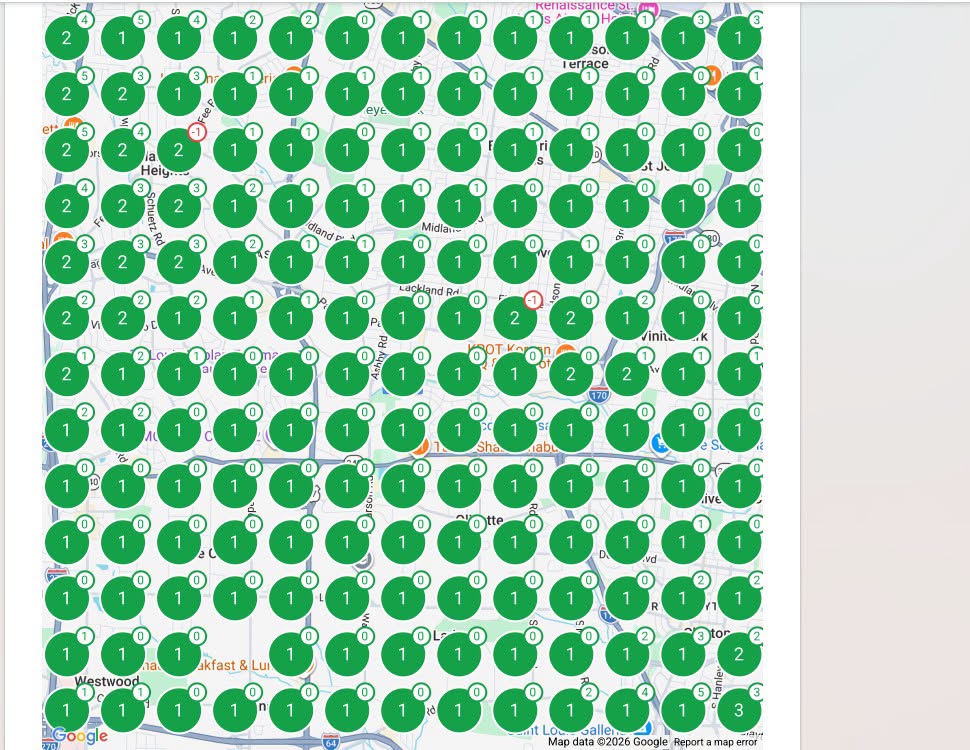
For a business people travel to, a coarse grid is enough. For a dentist, patients choose by neighbourhood, so coverage has to be measured street by street. A gap that looks small on a map is a whole catchment of patients who will never see the practice exists.
Before and After
| Measure | At the start | After the campaign |
| Map pack coverage | Immediate area around the practice | Across the city grid |
| Google Business Profile categories | 1 (Dentist) | 6, covering each treatment area |
| Treatments listed as services | 0 | Every treatment offered |
| Website treatment pages | 1 combined page | A full page per treatment |
| Emergency dentistry content | None | Dedicated urgent-care page |
| Clinician profiles | None | Named profiles with qualifications |
| Review collection | Incidental, a handful a year | Systematic at checkout, replies within 48 hours |
Services Provided
- Local SEO for healthcare
- Google Business Profile rebuild and category strategy
- Treatment page content and clinician profiles
- Website design and development
- Neighbourhood page research and content
- Review system design and reply policy
What the Practice Said
Key Takeaways
In dentistry, coverage is the whole strategy
Patients choose by proximity. Every neighbourhood where your listing does not appear is a catchment you are not competing in at all — and the practice never sees those patients, never hears from them, and never knows they existed. Widening coverage does not require another building. It requires Google to understand what you do and where.
One category is one doorway
A practice listed only as “Dentist” is competing for one search. Listed correctly across its actual treatment areas, it competes for many — without changing anything clinically.
Emergency searches are the fastest conversions you will ever see
Someone in pain at eight in the morning is not reading your treatment philosophy. They want to know if you can see them today and what number to ring. Build that page for that person.
Publish your fees
Patients researching implants or orthodontics will find a price somewhere. Better that they find yours, in context, with what it includes — than a competitor’s headline figure with nothing behind it.
Which neighbourhoods can see your practice?
We will run a dense coverage grid across your city and show you exactly where patients can find you and where they cannot.
- A street-level coverage grid across your catchment
- A category and services audit against the treatments you actually offer
- The neighbourhoods worth winning first
- No contract, no obligation
Ready to Achieve Similar Results?
Every business is unique, but success follows proven strategies. Let’s discuss how we can create a custom solution for your specific goals and challenges.