

Every month, about 3,600 people in Jacksonville search for a moving company and 2,400 search for a roofer. They are not searching for anyone by name. They are searching for the service. You probably typed “SEO agency Jacksonville” to find this page, but your customers type the name of your trade, and this page is about who gets their call.
Key Takeaway
Your customers here live in 413,620 households, and 58.1% of those homes are owner-occupied. The median household income is $72,389. Every month, 3,600 of them search for a moving company, 2,400 for a roofer and 880 for landscaping. For each of those searches, three businesses get the box at the top of Google. Which three depends mostly on where your pin sits, your reviews and how active your listing is. It depends much less on your website. A listing pinned in the city can fade just 11.8 miles away in Orange Park.
Why can you be first on Google in Jacksonville and still get no calls?
The box at the top of Google and the plain blue links underneath are two separate systems, so you can win one and lose the other.
The box at the top shows three businesses on a map, with a call button beside each name. The plain blue links underneath are websites. Google fills them using different rules. That is how a business can hold the top blue link and still be missing from the box.
Google Business Profile The free listing that puts your name, pin, hours, photos and reviews in the box at the top.
The box runs mostly on three things. The first is how close you are to the person searching. The second is your reviews. The third is how active your profile is. The blue links run on your pages and on links to them from other websites. Most of what gets sold as local SEO in Jacksonville is work on the box, because that is where the call button sits.
| What decides it | The box at the top | The links below |
| The biggest factor | How close your pin is to the person searching | Your pages, and the links pointing to them |
| Reviews | The count, the rating and how recent they are all matter | Little direct effect |
| How long it takes to move | Weeks, if the listing has a fixable fault. Longer if it doesn’t. | Usually months |
| The next town over | You fade as the searcher moves away from your pin | A good page about that town can rank wherever the searcher is |
So when someone tells you that you rank first, ask them which one they mean. Being first in the blue links with no place in the box is a common reason a phone stays quiet.
What this means for you
Check the box, not just the links. If you are missing from the box for your main service, that is where the calls are going, whatever your website report says.
Why does searching your own business name prove nothing?
People who already know your name will find you anyway. The customers you are missing search for the service, not for you.
Search your own business name and you will almost always come up. That tells you Google knows you exist. It tells you nothing about the people who have never heard of you.
Those people type the trade. Every month about 880 people here search for window replacement, 720 for deck building and 480 for home remodeling. Every one of them is searching for the service, not for a name, and they will call one of the first businesses they see.
- Use your phone, logged outOpen a private browser tab so your own search history does not help you.
- Search the service, not your nameType what a stranger would type: your trade plus the town, or your trade plus “near me”.
- Check the box firstSee whether you are one of the three names at the top. Then look at the blue links.
- Repeat from a job siteRun the same search from a customer’s street a few miles away. The answer often changes.
It also helps to know who these searchers are. 58.1% of homes in the city are owned rather than rented, and the median home is worth $325,300. An owner is spending money on a house he plans to keep. That is a customer worth being found by.
When you went looking for help, you might have said “SEO near me” into your phone. Your customers do the same thing for your trade: “roofer near me”, “movers near me”. That is the search to test, not your own name.
Why do you disappear one town over?
Google builds the box at the top around two things: the pin on your listing and the person searching. It does not build it around the area you are willing to drive to.
When someone searches for a service, Google looks at where they are. It then favours businesses whose pin sits close to them. Your service area setting tells customers where you work. It does not stretch your ranking to cover all of it.
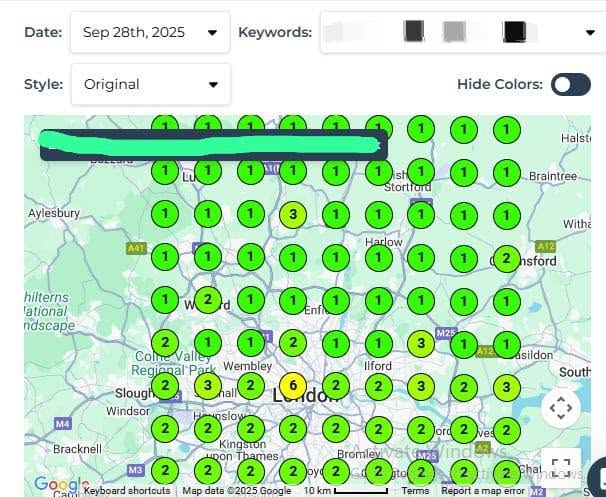
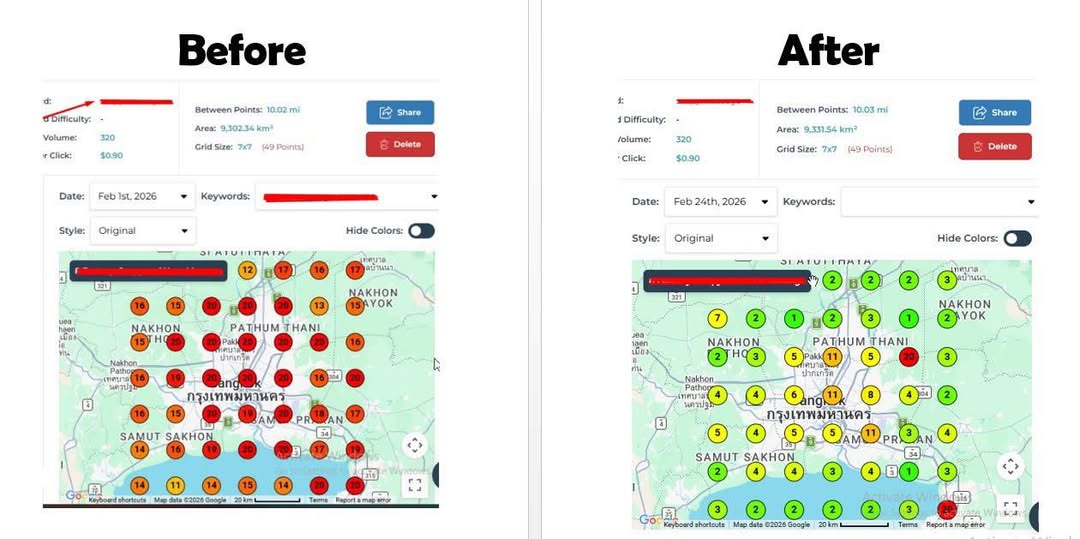
So a business pinned inside the city can show well near its own address and fade as the searcher moves away. Here is what that pattern often looks like against the three towns nearest to you:
Those are straight-line distances, not driving distances. 11.8 to 16.1 miles is nothing to a crew with a truck. In the box at the top, it can be the difference between a call and no call. Few people explain this to you, because the fix is slow and it does not sound exciting.
Why the city is not one market either
Jacksonville holds 1,009,831 people in 413,620 households. That is a lot of streets for one pin to cover. Even inside the city limits, someone searching across town can see different names in the box than someone searching near you.
Plenty of agencies sell local SEO in Florida as if the state were one market. For the box at the top, your market is the few miles around your pin. Anything beyond that you earn one area at a time, in this order:
- Fix the listing itselfSet the right primary category, add the right secondary ones, confirm the address and remove any duplicate listings.
- Build one page per areaWrite about the real work you do there. A page that just swaps one town name for another will not do it.
- Earn reviews from jobs thereAsk customers in that area the same way you ask everyone else.
- Post work from thereAdd photos and updates from real jobs in that town to your listing.
- Get mentioned locallyGet listings and links from sources in that area.
For a dental practice, Google Business Profile categories expanded from 1 to 6 and coverage extended city-wide.
Why an area page needs real local detail
A page about a town has to say something that could only be true of that place. The housing gives you that. The median home in the city was built in 1990, and 62.1% of homes went up before 2000. Older houses need different work from new builds: repairs, replacements, and upgrades to parts of the house that have been working for decades. A page that describes that work, in that area, reads like it was written by someone who has been there.
The area is also still growing. Population rose 6.3% over five years. New households arrive with no roofer, mover or landscaper they already trust, so they search. If you only show near your own pin, most of them never see your name.
What this means for you
If most of your work comes from outside the few miles around your pin, you are relying on the hardest part of Google to reach. That can be fixed, but it is built town by town. It is not switched on.
Want to see where you show up and where you vanish? Start with the check below.
How many Google reviews do you actually need?
You need enough to be within reach of the three businesses in the box for your service. There is no fixed number, because distance and relevance count as much as the total.
A business with a few dozen reviews can beat one with hundreds. It can do this if it sits closer to the searcher and its listing matches the search better. Relevance means your categories, your listed services and the words in your reviews match what was typed.
Steady beats sudden. A burst of reviews in one week followed by a year of silence does little for you, and customers notice the gap. These habits keep reviews coming honestly:
- Ask every customer at the end of a finished job, not only the ones you know are happy.
- Send your direct review link by text the same day, while the job is fresh.
- Reply to every review, good and bad, in plain words.
- Keep asking every week, so new reviews keep arriving.
No single review target fits every trade. The three names in the box for roofing are not the three for moving. Look at your own three, count their reviews and note the lowest. That lowest count is your first target, not the highest.
Why does a worse-looking website outrank yours?
Google ranks pages on whether they match the search and whether other sites vouch for them, not on how they look.
A plain site that names the service, the area and the work in clear words can outrank a polished one with a video and a slogan. Google does not rank a page higher for looking good. What it looks at is what the page says and who links to it.
In the box at the top, the website matters even less. A listing with no website at all can hold a place there, because the listing itself carries the reviews, the photos and the phone number. Here is what does not help your ranking:
- A new theme or colour scheme
- A video or slider on the home page
- Stock photos in place of your own work
- A redesign that deletes old pages that were already bringing visitors
None of that means your site does not matter. Design turns a visitor into a call. Ranking is what brings the visitor in the first place. You need both, but they are fixed separately, and paying for one will not buy you the other.
What happens to your Google listing if you move premises?
Changing the address on your listing can trigger a fresh verification, and the listing can dr